Double-tap the band on your wrist to record. KeepSay turns what was said into notes and a mind map, and every point shows the moment it was said. Beside them is the day your body had: heart rate, sleep and steps, kept on your phone.
The doctor explains the new dose, and by the car park half of it has gone. The lecturer says the one thing that will be in the exam while you are still writing down the last thing. A meeting ends with a decision, and a week later three people remember three versions of it.
An idea arrives on a walk, whole and bright, and by the time you find a pen it has gone. You tell the doctor you haven't been sleeping well, but you can't say since when. Your heart races through a hard conversation, and afterwards you can't say when it started. Someone you love says something worth keeping, and you didn't know it was the moment to write it down.
Recorders already existed. Every phone has voice memos. But a recording nobody plays back is only a heavier way of forgetting: hours of audio, and not one sentence you can find when you need it.
So I built what I wanted to exist. A band with one button, so an idea or a conversation is kept with a double tap on your wrist, not an app you have to open. An app that turns what was said into notes you can trust: not a summary that merely sounds right, but notes where every point shows the moment it was said, so you can check it for yourself. And because the band is on your wrist anyway, it keeps your sleep, your steps and your heart rate too, on your phone and nowhere else, so the story of your day and the words in it sit side by side.
I learned the band's language byte by byte and tested every command on the real thing. Along the way I wrote down the rules KeepSay is never allowed to break, and built them into the code rather than the small print.
Your words are yours. Nothing you record or measure is sold, there are no adverts, and your recordings never train AI models.
Every point shows its source. If a point can't be traced to something that was actually said, it doesn't appear.
Your body stays with you. The readings from your band stay on your phone. Back them up if you like: they are sealed first, and only you can open them.
You choose what is sent. A recording leaves your phone only when you send it, and its audio is deleted once your notes are written. Back up its audio if you like: it is sealed first, and only you can open it.
It records. It never diagnoses. KeepSay tells you what was said, never what it means for your health.
Every language counts. Speak in one language and read your notes in another, anywhere in the world.
Honest about the price. Five hours a month are free; Plus and Pro pay for the servers that write your notes, so nothing else has to.
KeepSay is for the idea you would otherwise lose on the way home, the appointment you're nervous about, the lecture you can't afford to miss, the meeting that matters, and the ordinary Tuesday you'll want back one day. It's for anyone who has walked out of a room and wondered what exactly was said.
Now you'll know.
The maker of KeepSay
The KeepSay band is coming soon.
One button, no screen, and room for about 14 hours of what was said. It will be £75, or £99.99 with a year of Plus. We're getting it ready to order. Register your interest and you'll be among the first to know.
The band, in silhouette until it's ready
Still being made.
The KeepSay band is in the workshop: one button, no screen, and room for about 14 hours of what was said.
Grab the sheet and pull. It never tears.
Tap twice. It's recording.
The band has one button and no screen. It records on its own, whether your phone is nearby or not, and holds about 14 hours. When your phone is back in range, it brings the new recordings over.
Double-tap to start
Try the band's button here.
00:00
Double tap
Start, or stop and save
Tap
Pause, or carry on
A rehearsal of the band's button. Nothing on this page records you.
Every point shows where it was said.
Send a recording and KeepSay names it and writes it up: a transcript, a summary, key points and to-dos. Each one is linked to the lines it came from, so you can check it for yourself. Anything that can't be traced back to a line is left out. With Plus, an infographic comes with the notes, in their language.
How memory works
Lecture · 52 min · Tuesday 23 September
Summary
Memory fades fast unless you come back to it. Sleep and testing yourself are what make a lecture stick, so review it on a spaced schedule.00:48Dr Hale Most of what you hear in a lecture is gone within a day, unless you come back to it.11:02Dr Hale Sleep is when the brain replays the day and moves it into long-term memory.18:40Dr Hale Rereading feels productive. Testing yourself is what actually makes it stick.24:12Dr Hale Space it out: the next day, then three days later, then a week.
Key points
Most of a lecture is forgotten within a day without review.00:48Dr Hale Most of what you hear in a lecture is gone within a day, unless you come back to it.03:15Dr Hale Ebbinghaus tested it on himself. The steepest forgetting happens in the first hour.
Sleep moves the day's learning into long-term memory.11:02Dr Hale Sleep is when the brain replays the day and moves it into long-term memory.
Testing yourself works better than rereading.18:40Dr Hale Rereading feels productive. Testing yourself is what actually makes it stick.
Review on a spaced schedule: the next day, three days later, a week.24:05You How often should we go back over it?24:12Dr Hale Space it out: the next day, then three days later, then a week.
To-dos
Read chapter seven before Thursday47:30Dr Hale For Thursday, read chapter seven and bring one question about sleep.
Bring one question about sleep47:30Dr Hale For Thursday, read chapter seven and bring one question about sleep.
Transcript
52:10 · every line kept with its moment
00:48
Dr Hale
Most of what you hear in a lecture is gone within a day, unless you come back to it.
03:15
Dr Hale
Ebbinghaus tested it on himself. The steepest forgetting happens in the first hour.
11:02
Dr Hale
Sleep is when the brain replays the day and moves it into long-term memory.
18:40
Dr Hale
Rereading feels productive. Testing yourself is what actually makes it stick.
24:05
You
How often should we go back over it?
24:12
Dr Hale
Space it out: the next day, then three days later, then a week.
47:30
Dr Hale
For Thursday, read chapter seven and bring one question about sleep.
An example lecture, written for this page. Tap a time to see where a point was said.
A map of every talk.
Each recording gets a mind map that opens whole and reads one way: its title first, its themes in a column beside it, and what was said at the end of every branch. Fold a branch with its ring, and tap what was said to see the line it came from.
How memory works
Forgetting
Sleep
Practice
For Thursday
Rereading feels productive. Testing yourself is what actually makes it stick.
Dr Hale · 18:40 · How memory works
The same example lecture, mapped as the app maps it: whole, one way, a column for each level.
Ask what was said.
Ask in your own words. KeepSay finds the matching lines on your phone and answers only from them, naming the recording and the minute. If the answer isn't in your recordings, it says so rather than guess. Asking your recordings is part of Plus.
To answer, your question and the few lines that match it go to the notes service, which deletes them once it has answered. Private shelves are never searched.
Ask me anything that was said. I'll answer only from your recordings and show you where it came from.
What did she say about rereading?
That testing yourself works better. Rereading feels productive, but testing yourself is what makes it stick.
How memory works · 18:40
When is my ECG due?
Before 15 November, booked with the practice.
Cardiology follow-up · 04:02
Did she say what's on the exam?
I couldn't find that in your recordings. I only answer from what was said, so I won't guess.
Example questions, answered from example recordings.
Your day and your week.
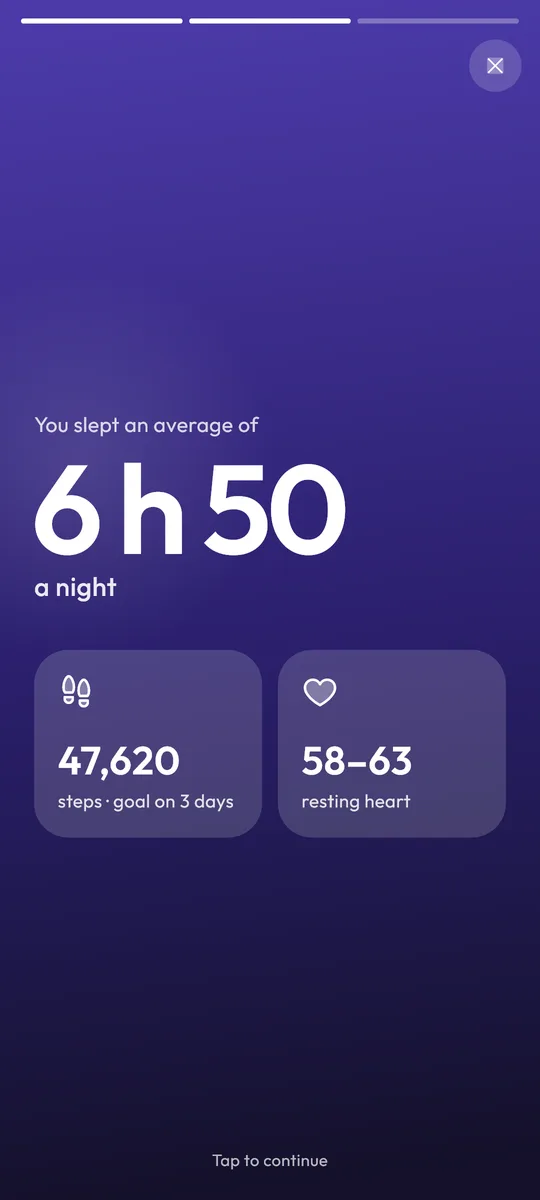
The band also measures heart rate, sleep, steps, blood oxygen and stress. KeepSay puts them in plain sentences and compares them only with your own days: no scores and no verdicts. A card in the morning and one in the evening say where things stand, and a recap shows you your week.
Your morning
You slept 6 h 56 and woke 3 times.
To do: Read chapter seven before Thursday.
2 recordings are waiting for you to send.
Remind me
Winding down
You recorded 3 things today. 2 have notes. One is waiting for you to send. Your band has enough battery for tonight.
Take a minute with me
An example day. KeepSay doesn't diagnose or give medical advice, and blood pressure is shown as the band's estimate.
Your week, a slide at a time. A screen from the app, with example readings.
Only you can read your health readings.
Nor does a recording's audio, unless you send it for notes or back it up, sealed so only you can open it. Here is where your data goes, how it is protected and what you can do about it. Each line links to the part of the Privacy Policy that says so.
Every KeepSay account turns five hours (300 minutes) of recordings a month into notes and mind maps, free. Plus and Pro make more hours and add more. Prices are in pounds for the UK; elsewhere, your app store shows them in your own currency.
Free
5 hours
a month of recordings, made into notes
£0
300 minutes, on every account, for good
Transcripts, notes, to-dos and mind maps
Everything the band measures, on your phone
No card, and nothing to cancel.
Plus
30 hours
a month of recordings, made into notes
£3.99 a month
or £34.99 a year, about £2.92 a month
Everything in Free
Ask your recordings
An infographic with every recording's notes, in their language
Choose your companion, your colour and your room
By the month, your first 14 days are free.
Pro
100 hours
a month of recordings, made into notes
£8.99 a month
for people who record most days
Everything in Plus
Your recordings go first in the queue
Move up from Plus in the app at any time.
The band Coming soon
The KeepSay band
£75
Health tracking free for good, and the five free hours a month every account has.
The band with a year of Plus
£99.99
The band, and a code in the box for twelve months of Plus: £10 less than buying the two apart.
Cancel Plus or Pro any time in your store's subscription settings.
If a plan ends, nothing on your phone is deleted, and your five free hours carry on.
No ads, and nothing you record or measure is sold.
Coming soon to Google Play
Or bring your own AI
Already have an account with an AI provider? A one-off unlock in the app, £14.99, connects KeepSay to your own accounts instead, and your provider bills you directly for what you use.
Your keys are kept in your phone's secure storage and never sent to us.
Recordings go straight from your phone to the providers you choose.
A test run checks each key when you add it, and every note shows roughly what it cost.
Before you ask.
How do I get the band?
Not quite yet: the KeepSay band is coming soon, at £75, or £99.99 with a year of Plus. Register your interest and we will email you once, when it can be ordered.
Which band does it work with?
The KeepSay band, a screenless band that records audio and measures heart rate, sleep, steps, blood oxygen and stress. The band keeps one Bluetooth connection at a time, so other apps paired with it need to be disconnected.
Does it work if my phone isn't with me?
Yes. The band records on its own, and your phone brings the recordings over the next time it's near. Once a checked copy is safe on your phone, the band clears its own.
Is there a free version?
Yes. Every account turns five hours (300 minutes) of recordings a month into notes, to-dos and mind maps, free, and everything the band measures is shown on your phone at no cost. Plus, £3.99 a month or £34.99 a year, makes 30 hours a month and adds asking your recordings, an infographic with every recording's notes, and choosing your companion, your colour and your room. Pro, £8.99 a month, makes 100 hours and its recordings go first in the queue. See the plans
Can I invite a friend?
Not yet. Invites open when the KeepSay band goes on sale. Then every account gets an invite code, and when a friend adds yours and their band connects for the first time, you each get a month of Pro. The invite rules
Is it a medical device?
No. KeepSay is a general wellbeing and note-taking product, not a medical device, and it mustn't be used to diagnose or monitor a medical condition. It summarises what was said and shows what the band measured; it doesn't give medical advice or read your mood from your voice, and it isn't an emergency service. Some readings, such as blood pressure, are the band's estimates.
Where are my notes made?
When you send a recording, our notes service transcribes it and writes it up with the help of an AI provider working on our behalf, for that purpose only. It is encrypted in transit, the audio is deleted once your notes are ready, and it is all handled under the GDPR's rules. If you use your own API keys, your notes are made by the providers you chose instead, straight from your phone. The Privacy Policy has the detail.
What AI does KeepSay use?
KeepSay uses advanced AI models, with checks of its own on top: every point in your notes is checked against what was said. Notes can still contain mistakes, which is why each point shows the lines it came from.
Can I use my own AI accounts?
Yes, with the Own-API option: a one-off unlock in the app that connects KeepSay to your own AI provider accounts instead of our notes service. Your keys stay on your phone, and your provider bills you directly.
Does the app use my phone's microphone?
Only when you record with your phone. With no band connected, a tap in the app starts your phone's own microphone and a tap stops it, and nothing listens at any other time. Your phone asks for the microphone the first time you do that, never during setup, and shows a notice with a Stop button for as long as it records. For now, recording with your phone is on Android. KeepSay also asks for Bluetooth, to reach the band; notifications, to tell you when notes are ready; and on Android, alarms, so a reminder goes off at the minute you set. Each comes with its reason before your phone asks.
Can I use it where I live?
Yes. The band and the app work anywhere in the world. The app speaks 19 languages: English, French, German, Spanish, Italian, Portuguese, Russian, Turkish, Arabic, Persian, Urdu, Hindi, Bengali, Punjabi, Chinese, Japanese, Korean, Indonesian and Malay, and it can write your notes in a different language from the one that was spoken. Your app store shows prices in your own currency.
My band came with a code. Where do I use it?
On our code page. Sign in with the Google account you use in the KeepSay app, type the 16 characters from the card, and Plus is added to your account for the time that comes with the code. Each code works once, on one account.
Can I take everything with me, or delete it?
Yes. You can export your data or delete your account in Settings, and you can delete everything KeepSay keeps on your phone in one step.
What's your favourite colour? With Plus, I'll wear it everywhere in the app. Try one here.
Everything you say, kept.
The band and the app are coming soon, with five hours of recordings a month made into notes, free, on every account.